
An Indian medical visa lets a foreign patient enter India for treatment. For citizens of the countries on the government’s e-Visa list, the quickest route is the e-Medical visa, applied for online. Patients from other countries apply through an Indian embassy, high commission or visa centre. This guide sets out the steps, the documents, the fees and the limits as the official portal states them, and says clearly where the portal is silent or unclear.
General information, not medical or legal advice. Visa rules and fees change. Check every point on the official portal or with the Indian mission before you apply. We read the portal on 3 October 2026.
In this guide
Table of Contents
Indian medical visa: what it is and who needs it
India issues a medical visa to foreigners who travel to a hospital in India for treatment, and a separate attendant visa for the people who travel with them. The e-Visa portal calls these the e-Medical visa and the e-Medical Attendant visa. Your hospital will normally ask you to hold the right Indian medical visa before it admits you. For example, NIMHANS says only foreign nationals with a valid Medical visa can be admitted, and its attendants need a Medical Attendant visa.
This guide is about the process, not about choosing a hospital. For that, read our medical tourism guide.
Indian medical visa: the six steps
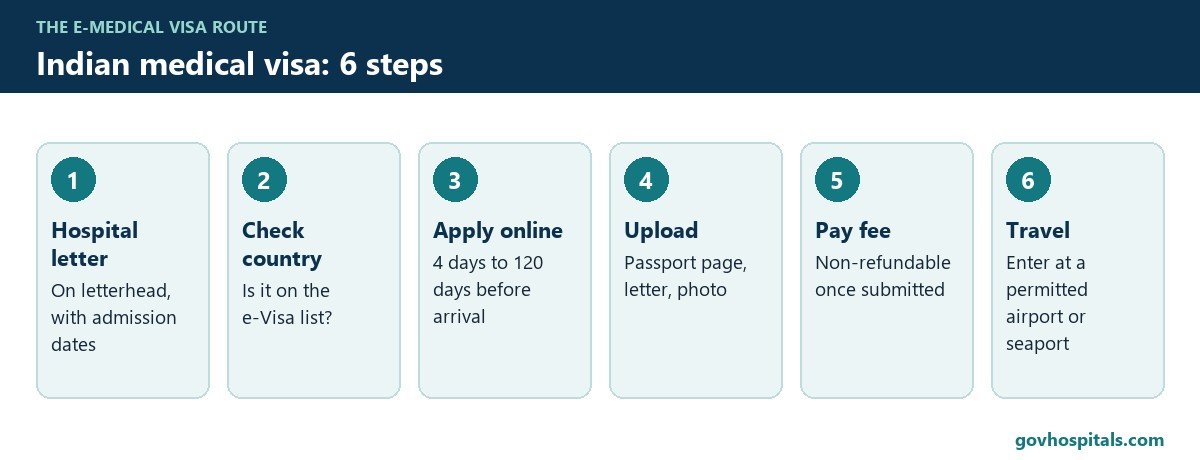
- Get the hospital letter. Send your reports to an Indian hospital and ask for a letter on its letterhead. The portal asks for it with the application.
- Check that your country is on the e-Visa list. If it is not, see the section on other routes below.
- Apply online at least four days before you arrive, and no earlier than 120 days before.
- Upload the documents: passport bio page, the hospital letter and a photograph.
- Pay the fee, if your nationality is charged one. It is not refundable once submitted.
- Carry the approval and your hospital letter when you travel, and enter at a permitted airport or seaport.
Who can apply for the e-Medical visa
The portal lists 175 countries that can use the e-Visa. When we read the list, Bangladesh, Kenya, Nigeria, Oman and Uzbekistan were on it. Iraq, Yemen, Sudan and Somalia did not appear on it, so patients from those countries should ask the nearest Indian mission which Indian medical visa applies. A country being absent from the e-Visa list does not mean treatment is closed to you. It means you apply through the mission instead.
Check your own country on the portal’s list before you start, because the list can change.
Documents for an Indian medical visa
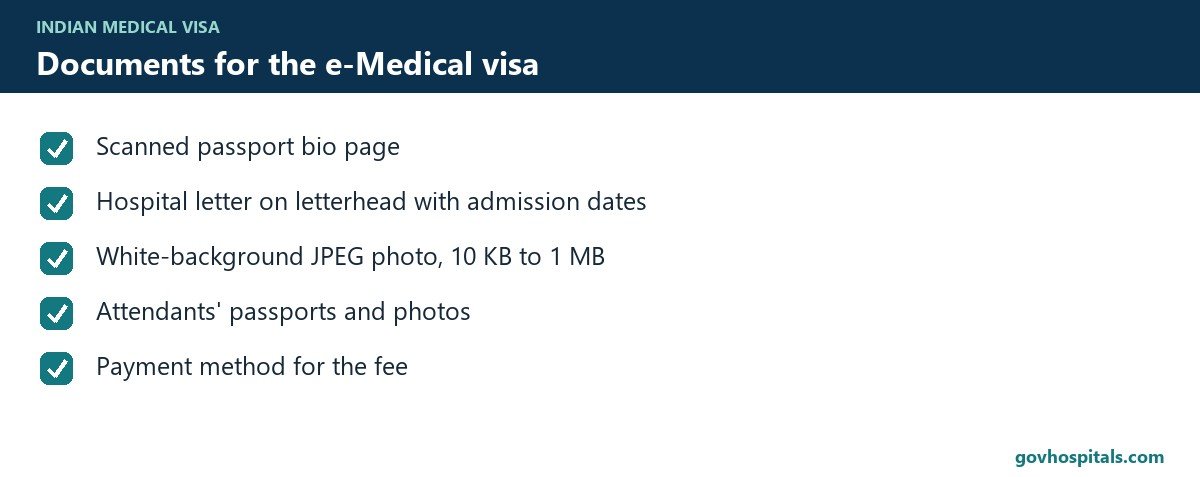
For the e-Medical visa, the portal asks for the following:
- a scanned copy of the passport bio page showing your photograph and details;
- a copy of the letter from the hospital in India, on its letterhead, giving the patient’s details and the dates of admission;
- a recent photograph with a white background, in JPEG format, between 10 KB and 1 MB.
Keep the originals with you. Your hospital may ask for more documents for its own admission process. At Tata Memorial, for example, the hospital’s page says the invitation letter covers the patient and up to two attendants.
When to apply and how long the visa lasts
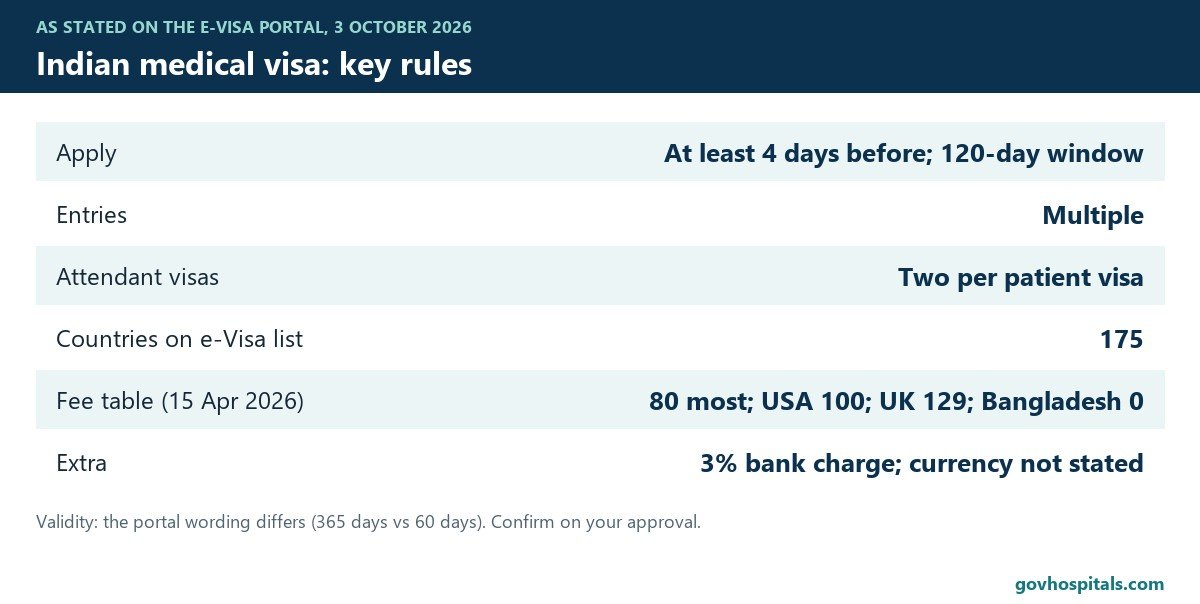
The portal says you may apply online at least four days before the date of arrival, and within a window of 120 days. Do not leave it to the last day, because the four-day minimum is a floor, not a promise of approval in four days.
On validity, the portal’s e-Medical visa details give the duration as one year (365 days) from the date of arrival, with multiple entries. Another part of the portal’s instructions has been read as giving 60 days from the first arrival. Because of that mismatch, confirm the validity on your own approval document and with your hospital, and plan the stay around what the document says.
Indian medical visa fees from the official table
The government publishes the e-Visa fees as a table in a PDF, dated 15 April 2026. For the e-Medical and e-Medical Attendant visa, the table lists 80 for most countries, 100 for the United States, 129 for the United Kingdom and 0 for Bangladesh, plus a 3 percent bank charge. The extract we read does not state the currency, so check the table for your nationality before you pay.
- The fee is non-refundable once the application is submitted.
- We found no emergency or express fee on the portal.
- Agents and facilitators may charge their own fees on top. Those are not government fees.
Attendants on an Indian medical visa
The portal says only two e-Medical Attendant visas are granted against one e-Medical visa. So a patient can bring at most two attendants on the e-Visa route. Some hospitals set their own rules as well. Tata Memorial says an international patient must be accompanied by an attendant, so the attendant’s visa belongs in your plan from the start.
Where you can enter India
The portal says the e-Medical visa can be used to enter through 36 designated airports, including Delhi, Mumbai and Chennai, and 38 designated seaports. Land entry is not part of that list as we read it. Check the list on the portal for the entry point you plan to use.
If your country is not on the e-Visa list
If your country is not on the list, apply for an Indian medical visa at the Indian embassy, high commission or authorised visa centre in your country. The document list and the fees are set by the mission, so they can differ from the e-Visa rules above. Ask the mission what it needs, and keep the hospital letter ready, because it is the document every route asks for in some form.
For patients from Bangladesh, which sends more medical travellers to India than any other country, we are preparing a separate guide. Until it is published, use the High Commission of India in Dhaka and the visa application centre for current rules.
Processing time: what is and is not published
We found no official processing time on the e-Visa portal. Many agency sites quote a few working days, and others quote weeks, and they do not agree. Treat those as unofficial. Apply as early as the 120-day window allows, rather than counting on a fast result.
Common mistakes with an Indian medical visa
- Applying on a tourist visa and planning treatment. Some hospitals admit only Medical visa holders. NIMHANS is one.
- Forgetting the attendant visa. Each attendant needs their own.
- Applying less than four days before arrival. The portal sets four days as the minimum.
- Trusting a fee quoted by an agent. Use the official fee table. The fee is non-refundable.
- Relying on an old validity statement. The portal’s wording on validity is inconsistent, so check your own document.
- Using a site that only looks official. The official address is indianvisaonline.gov.in.
Frequently asked questions
What is an Indian medical visa?
It is the visa a foreign patient needs to enter India for treatment. The online version for eligible countries is called the e-Medical visa, and attendants apply for an e-Medical Attendant visa.
How early can I apply for an Indian medical visa online?
The portal says at least four days before arrival, within a window of 120 days.
How many attendants can I bring?
Two e-Medical Attendant visas are granted against one e-Medical visa.
How much does an Indian medical visa cost?
The official fee table dated 15 April 2026 lists 80 for most countries, 100 for the United States, 129 for the United Kingdom and 0 for Bangladesh, plus a 3 percent bank charge. The currency is not stated in the extract we read.
Can the fee be refunded?
The portal says the fee is not refundable once the application is submitted.
How long does an Indian medical visa take to process?
The portal publishes no processing time that we could find. Apply early.
How long is it valid?
The portal’s e-Medical visa details say one year (365 days) from arrival with multiple entries, but other portal text has been read differently. Confirm the validity on your approval.
What if my country is not on the e-Visa list?
Apply through the Indian mission or visa centre in your country, and ask which documents it needs.