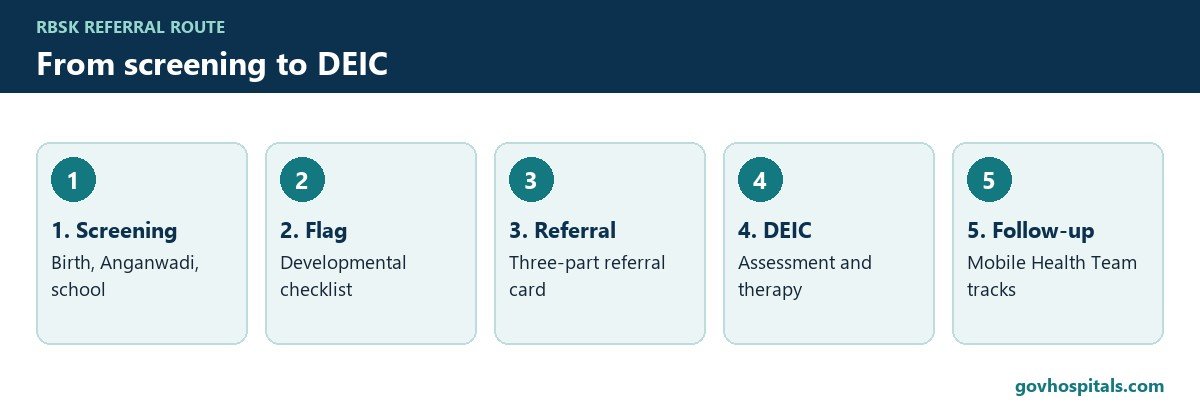
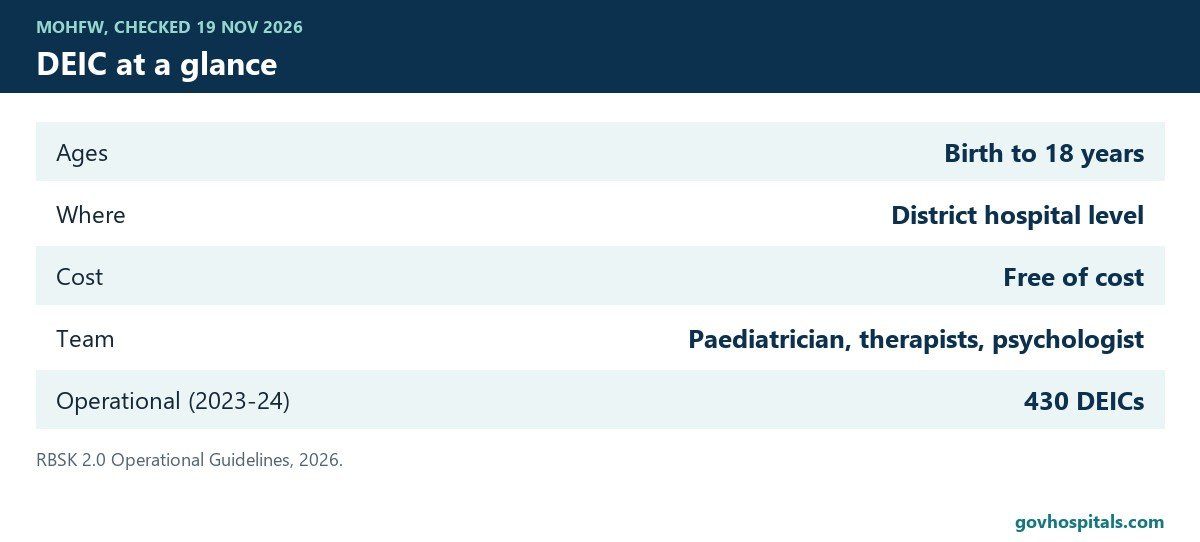
A DEIC centre (District Early Intervention Centre) is a free government unit, usually at the district hospital, where children from birth to 18 years with developmental delays, including autism, are assessed and given therapy under the Rashtriya Bal Swasthya Karyakram (RBSK) of the National Health Mission. Children usually reach it through referral from RBSK Mobile Health Teams, which screen children at Anganwadi Centres and government schools, or from newborn screening at a government hospital. The RBSK 2.0 guidelines of 2026 say all DEIC services are to be free of cost.
Facts below were checked on 19 November 2026 in Ministry of Health and Family Welfare guidelines on nhm.gov.in and a Rajya Sabha answer; each source is listed at the end.
Table of Contents
What is RBSK, and does it cover autism?
RBSK screens children for the “4Ds”: defects at birth, deficiencies, diseases and developmental delays. The Ministry of Health’s RBSK 2.0 Operational Guidelines (2026) expand the programme to “developmental disorders such as autism”. Their list of conditions for screening and early intervention now names autism and autism spectrum disorder (ASD) under developmental delays, alongside motor, cognitive and language delay, global developmental delay, ADHD and specific learning disorders. The list says these are covered for early detection, free treatment and management.
Who screens children under RBSK, and when?
| Age group | Where and by whom | How often |
|---|---|---|
| Newborns (0-6 weeks) | Delivery points in public health facilities; ASHAs on home visits | At birth and during home visits |
| 6 weeks to 6 years | Anganwadi Centres, by the RBSK Mobile Health Team | At least twice a year |
| 6 to 18 years | Government and government-aided schools, by the Mobile Health Team | At least once every academic year |
Each block has dedicated Mobile Health Teams. Under RBSK 2.0 a team has two medical officers (MBBS, BDS or AYUSH), one ANM, MPW or staff nurse, and one pharmacist. Their toolkit includes a card with an age-wise developmental checklist to record milestones from 6 weeks to 9 years. A child flagged in screening gets a three-part referral card and is referred to the DEIC centre or another facility.
What does a DEIC centre do for autism and developmental delay?
The RBSK 2.0 guidelines call DEICs “the primary referral and service delivery hubs”, giving multidisciplinary therapeutic care to children from birth to 18 years. Their stated role includes:
- assessment of children aged 0-18 at the DEIC, and confirmation of diagnosis for referred children;
- screening newborns in the district hospital, SNCU and paediatric wards for hearing, vision, heart disease and other birth defects;
- follow-up of high-risk newborns (preterm, low birth weight, sick newborns);
- following every referral for developmental delay and keeping records;
- linking children to tertiary hospitals for specialist care.
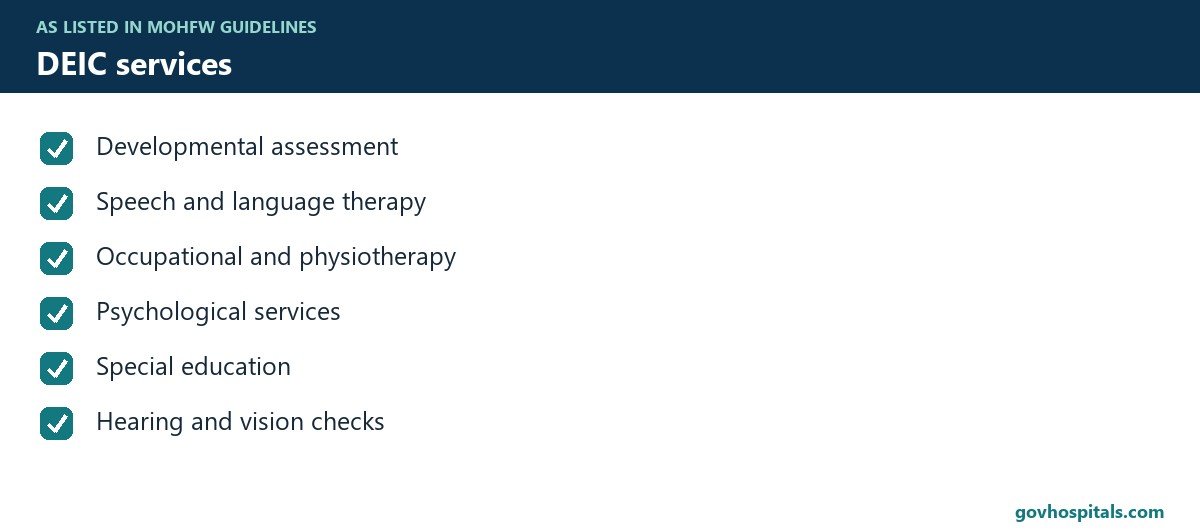
The 2014 DEIC guidelines describe the services in detail: occupational and physical therapy (including sensory integration and feeding difficulties), psychological assessment, counselling and parent training, cognition services, audiology, speech-language therapy, vision services, nutrition, social support and special education. They mention family support “esp. for children having Autism”, list standard Indian autism assessment tools (INCLEN-ASD or the Indian Scale for Assessment of Autism) among DEIC equipment, and give the DEIC manager a role in disability certificates with the disability board. For a child above 6, the 2014 guidelines also point to District Disability Rehabilitation Centres, Composite Regional Centres and National Institutes for rehabilitation.
Is treatment at a DEIC free?
Yes, according to the Ministry. The RBSK 2.0 guidelines say: “All services at DEICs are to be provided free of cost to all eligible beneficiaries.” For care a DEIC cannot give, children are referred to designated public tertiary hospitals; funds for tertiary management come under the National Health Mission, and the guidelines say all children diagnosed under RBSK 2.0 are entitled to surgical services at secondary and tertiary level as per NHM norms, with costing aligned to PM-JAY. Families may also be eligible for the National Trust’s Niramaya health insurance scheme, which reimburses therapy and OPD costs for autistic children.
Who works at a DEIC centre?
The RBSK 2.0 guidelines keep the DEIC team set in earlier guidelines. This is the staffing norm, not a guarantee that every post is filled in every district:
| Professional | Number |
|---|---|
| Paediatrician, medical officer, dental doctor | 3 (one each) |
| Physiotherapist / occupational therapist | 1 |
| Audiologist and speech therapist | 1 |
| Psychologist | 1 |
| Optometrist | 1 |
| Early interventionist cum special educator cum social worker | 1 |
| Lab technician | 1 |
| Dental technician | 1 |
| Manager | 1 |
| Data entry operator | 1 |
How do you reach a DEIC centre for your child?
- Through RBSK screening. If your child attends an Anganwadi Centre or a government or government-aided school, the Mobile Health Team screens there. Tell the Anganwadi worker or the teacher about your concerns before the team visits.
- Through the ASHA or Anganwadi worker, who can connect you to the block’s Mobile Health Team.
- At the district hospital. The 2014 guidelines place DEICs at the district hospital level. Ask at the paediatrics OPD or the hospital enquiry desk for the DEIC or RBSK coordinator.
- From a government hospital paediatrician. Newborns found with conditions at government delivery points are referred to the DEIC for confirmation and management.
The guidelines describe the referral route; they do not say whether a family can walk in without a referral, and they do not give opening hours. Carry your child’s birth record, any old reports and the referral card if you have one. Our checklist of what to carry to a government hospital helps.
How many DEICs are there, and is there one in my district?
In a Rajya Sabha answer on 11 February 2025, the Ministry of Health said 430 DEICs and 11,821 Mobile Health Teams were operational in 2023-24, as reported by the states. Compare your state’s figure with its number of districts: not every district may have a DEIC yet. State-wise counts from that answer:
| State / UT | DEICs operational, 2023-24 |
|---|---|
| Madhya Pradesh | 51 |
| Maharashtra | 35 |
| Tamil Nadu | 35 |
| Andhra Pradesh | 34 |
| Odisha | 32 |
| Gujarat | 28 |
| Jammu and Kashmir | 22 |
| Haryana | 21 |
| Assam | 18 |
| Telangana | 18 |
| Rajasthan | 17 |
| Karnataka | 14 |
| Kerala | 14 |
| Bihar | 9 |
| Himachal Pradesh | 9 |
| Manipur | 9 |
| Jharkhand | 8 |
| Uttar Pradesh | 8 |
| West Bengal | 8 |
| Chhattisgarh | 7 |
| Punjab | 5 |
| Uttarakhand | 5 |
| Arunachal Pradesh, Meghalaya, Tripura | 3 each |
| Delhi, Goa, Ladakh, Mizoram, Dadra and Nagar Haveli and Daman and Diu | 2 each |
| Chandigarh, Nagaland, Puducherry, Sikkim | 1 each |
| Andaman and Nicobar, Lakshadweep | 0 |
| India | 430 |
The answer notes that Andhra Pradesh screens children through PHC medical officers and ANMs, and Kerala through Junior Public Health Nurses, instead of Mobile Health Teams, and Delhi screens children under its own School Health Scheme. We found no public national list of DEIC addresses; the RBSK portal is a login system for health staff. Your district hospital or the district Chief Medical Officer’s office can tell you where the nearest DEIC is.
Where else can families get government help for autism?
For a disability certificate and UDID card, see disability certificate for autism and UDID card for autism. For specialist assessment, see government hospitals for autism in India, the AIIMS autism clinic, NIMHANS OPD and, in Delhi, free autism help from the Delhi Government.
Frequently asked questions
What is a DEIC centre?
A District Early Intervention Centre, set up under RBSK at the district hospital level, where children with birth defects, deficiencies, diseases and developmental delays are assessed, treated and followed up.
Is autism covered under RBSK?
Yes. The RBSK 2.0 Operational Guidelines of 2026 list autism and autism spectrum disorder among the developmental conditions for screening and early intervention.
Up to what age does a DEIC see children?
The RBSK 2.0 guidelines say birth to 18 years. The older 2014 guidelines focused mainly on children up to 6.
Do I have to pay at a DEIC?
The guidelines say all DEIC services are to be free of cost to eligible beneficiaries.
DEIC सेंटर क्या है और ऑटिज़्म वाले बच्चे को वहाँ कैसे ले जाएँ?
DEIC (जिला शीघ्र हस्तक्षेप केंद्र) राष्ट्रीय बाल स्वास्थ्य कार्यक्रम (RBSK) के तहत आमतौर पर जिला अस्पताल में होता है। यहाँ जन्म से 18 वर्ष तक के बच्चों की जाँच और थेरेपी होती है, और 2026 के RBSK 2.0 दिशानिर्देशों में ऑटिज़्म शामिल है। दिशानिर्देशों के अनुसार सेवाएँ मुफ्त हैं। आंगनवाड़ी कार्यकर्ता, आशा, सरकारी स्कूल में आने वाली RBSK मोबाइल हेल्थ टीम या जिला अस्पताल की बाल रोग ओपीडी से रेफ़रल लें।
This is general information about government services, not medical advice. A developmental paediatrician, child psychiatrist or clinical psychologist diagnoses autism. In an emergency call 112. Programme facts checked on 19 November 2026.
Sources checked
- MoHFW, Rashtriya Bal Swasthya Karyakram (RBSK 2.0) Operational Guidelines 2026 (PDF), read 19 November 2026: 4Ds, autism and ASD in the condition list, screening platforms and frequency, Mobile Health Team composition and toolkit, DEIC role, birth to 18 years, services free of cost, DEIC staffing table, three-part referral card, tertiary referral and NHM funding.
- MoHFW, Setting up District Early Intervention Centres: Operational Guidelines, May 2014 (PDF): DEIC at district hospital level, detailed list of services, family support for autism, autism assessment tools, disability certificate role, links to DDRC, CRC and National Institutes.
- PIB, Update on the Rashtriya Bal Swasthya Karyakram, Rajya Sabha reply of 11 February 2025: 430 DEICs and 11,821 Mobile Health Teams, state-wise counts for 2023-24, Andhra Pradesh, Kerala and Delhi notes.
- National Health Mission, RBSK guidelines page: index of the official RBSK and DEIC guidelines.